
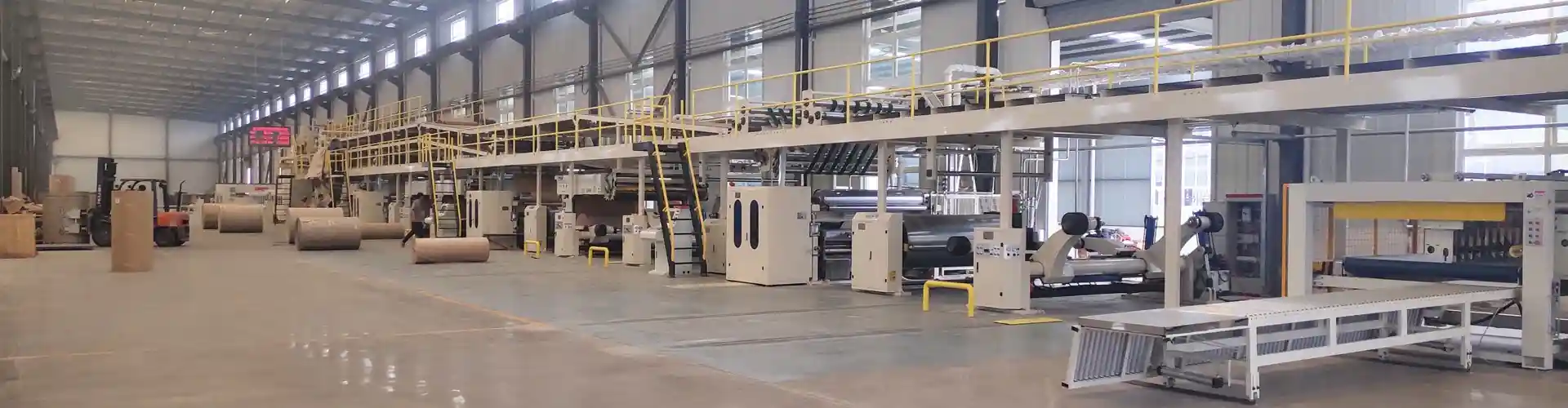
01What a corrugated cardboard making machine produces
A corrugated cardboard making machine converts liner and fluting paper rolls into continuous 3, 5 or 7 ply corrugated board. The right configuration depends on the board strength, order mix, working width, output and factory utilities your plant actually needs.
Different ply boards have different strength, weight limit and cost. They fit different local and export orders.
- Structure
- Face paper + corrugated medium + liner paper
- Advantages
- Less paper, low cost, flat surface, good printing
- Weak point
- Not strong for high stacking or long sea shipping
- Max weight
- ≤ 5 kg
- Use cases
- Cross-border express boxes, clothes, small goods, gift boxes, snack boxes
- Flutes
- B flute, E flute
- Structure
- Face paper + corrugation + medium + corrugation + liner
- Advantages
- Balanced burst strength, edge crush and cushion — the most widely used
- Weak point
- Not strong enough for very heavy stacking or long ocean shipping
- Max weight
- 5 – 30 kg
- Use cases
- Appliance parts, wine, farm goods, auto parts, normal export containers
- Flutes
- BC flute (most popular), AB flute
- Structure
- Face + corrugation + medium + corrugation + medium + corrugation + liner
- Advantages
- High edge crush, puncture resistance, strong for heavy stacking and sea transport
- Weak point
- Uses much more paper, higher cost, fewer orders in the market
- Max weight
- ≥ 30 kg
- Use cases
- Construction machines, solar and storage equipment, big moulds, machinery export
- Flutes
- BAC, BAB
Quick summary: 3 ply for high-volume light e-commerce orders · 5 ply for normal industrial and export orders · 7 ply is a small market, only for heavy, high-value export products.
02Corrugated cardboard making machine configurations and key parts
Open the full corrugated carton production line range, then compare the dedicated 3 ply, 5 ply and 7 ply lines.
A corrugated cardboard making machine changes ply type mainly through the number of single facers. Compatible configurations work well, but changing ply types has limits and costs.
3 ply corrugated cardboard machine
Low cost, small space, easy to fix — but it only makes 3-ply board, which limits your business. Not the first choice for a new factory.
3 & 5 ply compatible machine
The most popular choice. It mainly runs 5-ply; switch on one single facer to make 3-ply. Flexible across e-commerce and industrial export orders, with reasonable cost, power and steam use.
7 ply machine (3/5/7 all-in-one)
Longer machine, bigger factory, more steam and power, higher price and maintenance cost. 7-ply orders are not common — without steady buyers the third single facer sits idle and raises depreciation.
Useful optional parts
Many buyers look only at the single facers and ignore the parts below, which is how export boxes end up failing.
- Multi-section preheaters — control paper moisture, stop board warping, meet export quality rules.
- Automatic glue machine — stable glue amount, fewer open joints and bubbles, better for long sea storage.
- High-speed computer slitter scorer — small size error, meets foreign packaging standards.
- Automatic stacker — neat stacking, less damage, good for full container loading.
- Steam system — a 7-ply machine uses much more steam, so you need a bigger boiler and pipes before installation.
Investment and running cost
Low startup cost, low power and steam cost. Limited profit potential.
Medium investment, reasonable energy use. Flexible orders — the best ROI for most board plants.
High startup cost, plus higher spare parts, energy and building cost. You need steady 7-ply orders to cover fixed costs.
03Corrugated cardboard making machine plans by factory type
Small carton factory — e-commerce and small orders
Recommended: 3 & 5 compatible machine
Order mix: 80% 3-ply e-commerce boxes, 20% normal 5-ply, almost no 7-ply.
Do not buy a separate 3-ply machine — it blocks your growth. No need to add the 7-ply unit either. You can run large 3-ply batches and make 5-ply board in-house instead of buying board from other suppliers.
Medium board plant — local packing plus export orders
Recommended: 7 ply machine, 3/5/7 all-in-one
Order mix: mostly 3-ply and 5-ply, plus steady heavy machinery and sea-freight 7-ply orders.
You can supply every board type and compete for heavy-pack contracts. The rule that matters: check local and overseas 7-ply demand first, so the unit gets enough running time.
Heavy packaging factory — machine export packing
Main: 7 ply machine, with single facers for 3 & 5
Order mix: mostly 7-ply, some 5-ply, few 3-ply.
This is a narrow market. Lock stable long-term buyers first, then buy the machine. Do not buy blindly.
Upgrading an old factory
Recommended: add one single facer to the existing machine
Your old 3-ply machine only makes 3-ply, but more 5-ply orders are coming in. Check factory space, steam and power first: adding one single facer turns it into a 3 & 5 compatible machine for far less than a new unit.
04Checklist: do you really need a 7 ply machine?
Buy the 7 ply machine only if all of these are true. Do not buy it if any of the second list is true.
- You have two or more steady long-term buyers for 7-ply board.
- 7-ply orders are at least 15% of your total volume — not trial orders.
- Factory length, boiler steam and electric power fit this long machine.
- You can buy strong kraft paper and heavy base paper easily, at a good price.
- You have workers who know how to adjust and run 7-ply board.
- You only want it to look fully equipped for customer visits.
- The 7-ply unit will run only a few days per year.
- Factory, steam or power is too small, and building changes would be expensive.
- Few local or overseas buyers need 7-ply board, so you only get small random orders.
05Seven ways to avoid a costly mistake
- Do not buy for the feature list. A 7-ply machine chosen only to look complete runs too few hours to pay for itself.
- Match flute types to orders. E-flute rollers for colour boxes; BC flute for normal industrial boxes.
- Plan for changeover time. 3-ply machines run faster; 7-ply machines take longer to set up. Leave time and paper waste for order changes.
- Prepare paper supply early. 7-ply uses a lot of strong kraft paper — watch paper price movements.
- Test before you promise. Many export buyers ask for ECT and BST reports; make sure the machine can produce board that passes them.
- Budget the spare parts. A 7-ply machine carries one extra set of rollers, glue wheels and bearings, so your spare parts stock is larger.
- Count the waste of switching. Frequent 3/5/7 changes create more paper waste, and it adds up over a year.
06Popular export industries by ply
Cross-border small goods, beauty products, home small items, clothing
Furniture parts, food, auto parts, small home appliances, normal hardware export
Construction machinery, solar panels, energy storage, generators, aluminium profiles, heavy moulds
07How to select a corrugated cardboard making machine
3 ply for high-volume light orders. 5 ply for all common packaging. 7 ply for high-value heavy export packaging.
Most new carton and corrugated plants should choose a 3 & 5 ply compatible corrugated cardboard making machine: it balances capacity, order flexibility and investment risk. Only choose the full 3/5/7 all-in-one when you have steady, large heavy export orders.
Not sure which one fits your order plan? Send us your numbers →08Questions buyers ask before they order
The ten questions that come up most often when a carton or board plant compares 3, 5 and 7 ply corrugated cardboard making machine configurations.
Can a 3 & 5 compatible machine switch between 3-ply and 5-ply often and still run stably?
Yes. It can switch several times a day. You need skilled operators to adjust glue, preheat and slitter settings, and stable raw paper quality helps a lot.
How much extra maintenance cost does a 7 ply machine add every year?
Usually 20% – 35% more. There is one more set of single facer rollers, glue wheels and bearings to check and replace.
Which industries buy boxes made on a 7 ply machine most?
Construction machinery, solar and energy storage, generators, aluminium profiles and heavy mould export companies.
What orders fit E, B, C and A flutes?
E flute for high-quality colour gift boxes. B flute for express shipping boxes. C flute for general storage boxes. A flute for heavy goods that need cushioning.
How much factory space does a new machine need?
A 3-ply or 5-ply line needs about 60 – 80 m. A 3/5/7 all-in-one 7-ply machine needs 90 – 120 m. We give you an exact layout once machine speed is confirmed.
How long does it take to change from one ply type to another?
3-ply to 5-ply takes about 15 – 30 minutes. Switching to 7-ply takes 30 – 60 minutes, because more single facers and guides need adjustment.
Is 7-ply board easier to warp or come unglued?
It can happen when paper moisture or glue is poorly controlled. With good preheaters and an automatic glue system, 7-ply board stays flat and strong for sea shipping.
What are the common test standards for export board?
ECT (Edge Crush Test) and BST (Burst Strength Test) are the most common. Many buyers also ask for water absorption and stacking test reports.
What boiler and power changes are needed to add a single facer to an old 3-ply machine?
Check steam flow and electrical load first. Larger boiler pipes and extra power cables are often needed; we calculate the requirement with you.
Can I add a single facer later to upgrade a 3 & 5 machine into a 7 ply machine?
It is possible but not always easy. Factory length, boiler, power and machine frame must have the space and capacity. Send the machine model and we will check.